
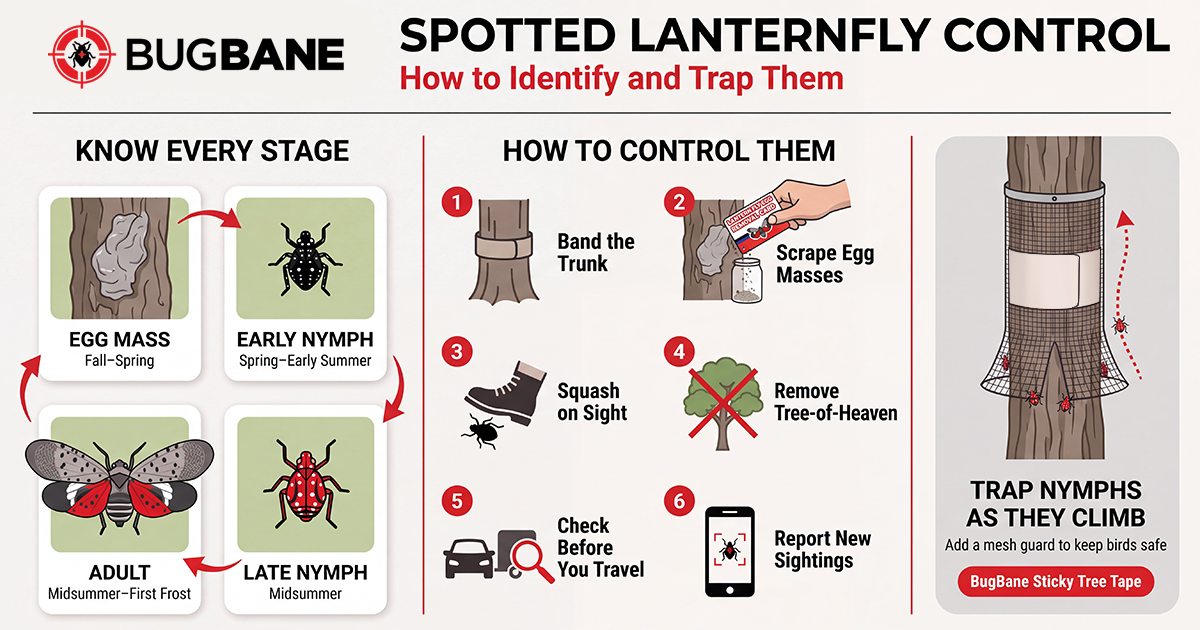
The spotted lanternfly is an invasive planthopper that feeds on the sap of trees and vines. It was first found in the United States in Pennsylvania in 2014 and has since spread to many eastern and midwestern states. It does not bite or sting people, but heavy feeding weakens plants, and the sticky honeydew it leaves behind coats decks, cars and outdoor furniture. This guide covers how to recognize it at each stage and what a homeowner can do about it.
How to identify a spotted lanternfly
The insect looks very different as it grows, so it helps to know all four forms.
- Egg masses (fall through spring). Rows of small eggs covered with a gray, putty-like coating that looks like a smear of dried mud, about an inch long. They are laid on tree bark, stone, firewood, vehicles and outdoor equipment.
- Early nymphs (spring to early summer). Small, black with white spots, and wingless. They hop when disturbed.
- Late nymphs (midsummer). Red with white spots and black stripes, up to about half an inch long.
- Adults (midsummer until the first hard frost). About an inch long. The front wings are gray with black spots. The back wings, seen when the insect jumps or flies, are red, black and white.
Spotted lanternfly life cycle
There is one generation a year. Eggs laid in fall survive the winter and hatch in spring. Nymphs climb up trees and plants to feed, fall or get knocked off, and climb back up again, many times over the season. Adults appear in midsummer, feed and mate, and lay eggs from early fall until a hard frost kills them. Exact timing shifts with local weather.
That repeated climbing is the habit that trunk traps take advantage of.
What do lanternflies damage?
Lanternflies feed on many plants. Their preferred host is the tree-of-heaven, an invasive tree common along roads and fence lines. They also feed heavily on grapevines, and on maples, black walnut, willow, birch and fruit trees. Around a home the most visible problem is honeydew, the sugary liquid they excrete. It drips onto whatever is below and grows a black, sooty mold.
How to control spotted lanternflies at home
1. Trap nymphs on the trunk
Because nymphs walk up tree trunks again and again, a sticky band wrapped around the trunk catches them on the way up. Banding works best from spring through midsummer, while the insects are still wingless nymphs.
- Wrap the band around the trunk at about chest height on trees where you see lanternflies feeding.
- Check bands often and replace them when they are full or dirty.
- Protect birds and small animals. Sticky bands can catch creatures other than insects. Build a guard of fine mesh, such as vinyl window screen, around the band, fixed at the top and open at the bottom, so that insects climbing the trunk walk under it and birds cannot touch the adhesive. Many state extension services show how to make one.
- Sticky Tree Tape — a trunk band for climbing lanternfly nymphs and other crawling insects
2. Scrape egg masses
From fall through early spring, look for egg masses on trunks, branches, stones, fence posts and anything stored outdoors. Scrape them into a bag or container of rubbing alcohol or hand sanitizer, seal it and throw it away. Each mass holds roughly 30 to 50 eggs, so every one removed matters.
3. Squash the ones you can reach
Nymphs and adults are quick jumpers but can be swatted or stepped on. Adults tire after a few jumps.
4. Deal with tree-of-heaven
Removing tree-of-heaven from your property takes away the favorite host. It resprouts strongly from the roots when cut, so ask your state extension service or a licensed tree professional for the right method.
5. Check before you travel
Lanternflies spread mostly by hitching rides. Egg masses on vehicles, trailers, firewood and outdoor furniture move them to new areas. Many states have quarantine zones with rules about moving these items. Look over your vehicle and anything you are moving, and check the rules for your state.
6. Report sightings where asked
If you see a spotted lanternfly in an area where it has not been confirmed, take a photo and report it to your state department of agriculture or extension service. In areas where it is already established, reports are usually not needed.
Spotted lanternfly FAQ
Do spotted lanternflies bite or sting?
No. They feed on plant sap and do not bite or sting people or pets.
When should I put up tree bands?
In spring, when the first black-and-white nymphs appear, and through midsummer. Bands catch far fewer adults, because adults fly.
What kills spotted lanternfly eggs?
Scraping the egg mass into rubbing alcohol or hand sanitizer, or crushing it thoroughly. Eggs scraped onto the ground can still hatch.
What trees do spotted lanternflies like most?
Tree-of-heaven is the favorite. They also gather on grapevines, maples, black walnut, willow and birch.
Will lanternflies kill my trees?
Healthy mature landscape trees usually survive lanternfly feeding, though heavy feeding causes stress. Grapevines and young trees are at greater risk.
Seeing nymphs on your trees? Shop BugBane Sticky Tree Tape on Amazon.