
How the ribbon works

BugBane Fly Ribbons are sticky hanging strips that capture flies and other flying insects by physical contact. Each ribbon is a paper strip coated on both sides with a non-drying adhesive. When a fly lands on or brushes against the ribbon, it sticks to the surface and cannot escape. The ribbon contains no insecticides and no bait or scent attractant; it works purely by trapping insects that come into contact with the glue. The ribbon is yellow, a color flies can see. It does not draw flies in from a distance, but it gives them an inviting place to land. Tired flies look for a spot in open space where they can rest and see around them, and a ribbon hanging free is that spot.

What it catches

The adhesive surface can catch a range of flying insects, including houseflies, cluster flies, fruit flies, gnats, and moths. Because the ribbon works by contact rather than attraction, it catches the insects that fly into it.

Where to hang it

  • Hang the ribbon where flies are a nuisance, such as near windows, doorways, light sources, garages, or sheds.
  • Position the ribbon along the flight paths insects use, rather than in a still corner.
  • Hang it free in open space, never against a wall. Keep it away from people, foot traffic, hair, and curtains. It should touch nothing, because the glue sticks to anything it touches.

What to expect

  • The ribbon catches insects on contact; there is no activation or waiting period.
  • Catch rate depends on placement and how much insect activity passes by the ribbon. If a ribbon is not catching anything, move it to a more active area.
  • Over time the adhesive collects dust and trapped insects, which reduces its tack. Replace the ribbon once it is full or after about three months.

Materials

The ribbon is made of reinforced paper coated with a non-drying synthetic-resin adhesive. It contains no insecticides. The strip ships rolled inside a cardboard tube with a hanging cord and a mounting pin.

Disposal

When the ribbon is full or spent, unhook it from whatever it hangs from, such as the thumbtack. To keep glue off your hands, cover the sticky part, or any part you need to touch, with a paper towel or other disposable item. Place the entire ribbon in your household waste. Wrapping it before disposal helps keep the sticky surface contained.
General Product Information
  • Brand: BugBane
  • Model Number:
    • FlyRib10 – Fly Ribbons – 10 Pack
    • FlyRib24 – Fly Ribbons – 24 Pack
    • FlyRib48 – Fly Ribbons – 48 Pack
  • Product Type: Adhesive Insect Trap
  • Primary Function: Capture and containment of flying insects via high-tack adhesive.
  • Target Species: Houseflies, Fruit Flies, Gnats, Cluster Flies, and Moths.
  • Ribbon Material: Reinforced paper (high tensile strength)
  • Adhesive Base: Insecticide-free, non-drying synthetic resin
  • Dimensions (Per Ribbon): ~2.0 inches (W)
  • Weight (Per Ribbon, Dry): ~60 grams (2.1 oz)
  • Housing Material: Compressed cardboard tube
  • Color: Golden Yellow (high-visibility for insects)
  • Retail Units: Sold in 10-, 24-, and 48-roll packs. The 48-pack arrives as two 24-packs wrapped together.
  • Inner Packaging: Individual rolls are sealed to preserve adhesive moisture.
  • Storage Requirements: Store in a cool, dry place out of direct sunlight to maximize shelf life.
  • Effective Duration: Up to about 3 months (depending on dust accumulation and insect saturation).
  • Operational Temperature: 10°C to 45°C (50°F to 113°F).
  • Note: At lower temperatures, the adhesive requires manual warming before deployment.
  • Weather Resistance: Moisture-resistant; suitable for high-humidity indoor areas or covered outdoor locations (porches/sheds).
  • Adhesive Strength: High-tack adhesive that holds insects on contact.
  • Attachment Method: Integrated hanging loop (poly-cord) plus included mounting pin.
  • Mounting Hardware: One steel thumbtack per roll, located inside the top cap.
  • Tension System: Gravity-fed. The bottom cardboard housing acts as a stabilizing counterweight to prevent curling.
  • Cleanup: Adhesive is soluble in lipid-based cleaners (vegetable oil) followed by a surfactant (soap).
  • Precautions: Keep out of reach of children and pets.
  • EPA Establishment Number: 93378-CHN-1
  • This product is a pesticide device under the Federal Insecticide, Fungicide, and Rodenticide Act (FIFRA). As a pesticide device it requires an EPA Establishment Number, not EPA registration.
DIRECTIONS FOR USE
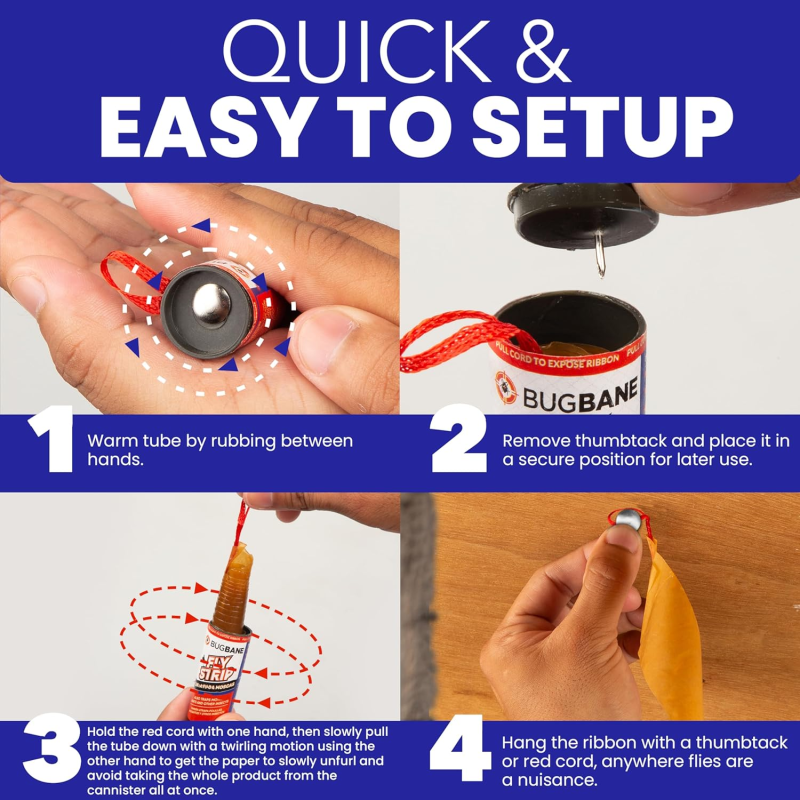
  1. Warm the tube by rolling it back and forth between your hands. This loosens the ribbon. It matters most in cold weather.
  2. Remove the lid and set the thumbtack aside in a secure location for later use.
  3. Hold the red cord with one hand, then slowly pull the tube down with a twirling motion using the other hand.
  4. Hang the ribbon by the thumbtack or red cord from a hook or the ceiling, where flies are a nuisance, so it hangs free and touches nothing.

To get the most out of your BugBane Fly Ribbons, use these placement and handling strategies:

  • Warm it up first: In cooler rooms the adhesive can be stiff. Roll the tube back and forth between your hands for a few seconds before pulling the cord. Softening the resin helps the ribbon extend fully without snapping.
  • Place it in the flight path: Because the ribbon works by contact, hang it a few inches away from a window or light source rather than in a dark corner. Flies move toward light, which increases the chance they contact the ribbon.
  • Keep it vertical: In areas with fans or open windows, attach a small paperclip to the bottom of the cardboard tube once unrolled. The extra weight keeps the ribbon hanging straight and stops it from sticking to walls or curtains.
  • Match the height to the insect: Hang ribbons higher (6–7 feet) for houseflies, which favor ceiling corners and light fixtures, and lower (3–4 feet) for gnats and fruit flies near tabletops, trash bins, or potted plants.
  • Remove it cleanly: Unhook a full ribbon from its thumbtack or hook. Cover the sticky part, or any part you need to touch, with a paper towel or other disposable item. Sliding a cardboard tube up over it from the bottom also works, but you do not need one.

Frequently Asked Questions

Slowly pull the ribbon away, then dab the affected area with oil-soaked cotton balls (vegetable, olive, or baby oil) until the glue dissolves. This may take a few minutes. Rub with a soft, dry cloth, then wash with soap and water.

Each ribbon lasts around 3 months. In a very dusty area it may not last as long, because dust landing on the glue eventually keeps it from working. Replace each ribbon after about 3 months, or once it is full of flies.

The ribbons are moisture-resistant and suitable for high-humidity indoor areas or covered outdoor locations such as porches and sheds. Avoid hanging them where they will be rained on directly.

No. The ribbons contain no attractant. They are coated only with sticky glue — no insecticides and no bait. The paper is yellow, a color flies can see, so it gives them an inviting place to land. Just make sure you do not hang them somewhere children or pets might walk into them.

BugBane Fly Ribbons can trap a range of flying insects on contact, including houseflies, cluster flies, fruit flies, gnats, and moths. Hang them in areas of high insect activity. If you are not catching anything, try moving the ribbon to another area.

  • Start with 1–2 ribbons per area and see how quickly they fill up.
  • Add more if you are seeing high fly activity — some customers hang several throughout a garage.
  • Spread them out near windows, light sources, doorways, or areas where you notice the most insect activity.
  • Move them around if they are not catching anything — placement matters more than quantity.
  1. Warm it up first — roll the tube between your palms for a few seconds before opening. Warmth makes the strip more pliable and less likely to tear or stick to itself.
  2. Pop off the lid gently — use the tab to open it; do not yank it.
  3. Unravel slowly — pull the strip out gradually and steadily; rushing is the main cause of tearing or tangling.
  4. Do not remove the bottom tab until the strip is fully hung and in place.
  5. Hang it first, then let it unwind — some customers attach the top cord first and let the strip unroll downward by gravity.

The glue has no insecticide and no bait. It is just very sticky, so place it where pets cannot reach or brush against it.

  • Glue in fur: rub the glue with a cotton ball soaked in vegetable oil until it loosens. Wipe it off with a dry cloth. Then wash with soap and warm water as soon as you can. Use oil, never a solvent.
  • Chewed or swallowed: if your pet chews or swallows any part of one, please call your vet. The concern is not poison. It is that your pet swallowed something it cannot digest.