Advanced Multi-Stage Attractant Technology

The heart of this BUGBANE trap is its Bio-Lure Refill Packets. Unlike simple sugar-water traps, these dissolvable packets contain a specialized blend of proteins and fermentation agents.

  • Rapid Dissolve: The bait is encased in a water-soluble film that disappears instantly, removing the need for messy mixing.
  • Pheromone Mimicry: Once fermented, the bait mimics the natural feeding and breeding sites of filth flies, ensuring they choose the trap over your patio or grill.

Heavy-Duty Reusable Construction

Designed to withstand the rigors of outdoor use, the Bugbane canister is built for longevity.

  • UV-Stabilized Housing: The plastic is treated to prevent yellowing, cracking, or becoming brittle after prolonged exposure to direct sunlight.
  • Eco-Conscious Design: By utilizing a reusable reservoir, the system significantly reduces plastic waste compared to “single-use” hanging bags that are thrown away once full.

Escape-Proof Entry Cone

The internal geometry of the trap is scientifically optimized for fly behavior.

  • One-Way Entry: Flies enter through the bottom or side ports but are unable to navigate back through the narrow cone once inside.
  • Clear Visibility: The transparent top allows you to monitor the “fill level” at a glance without having to open the unit or come into contact with the contents.

Safety-First, Pesticide-Free Formula

Bugbane prioritizes the safety of your home and environment by avoiding neurotoxins and synthetic poisons.

  • Pet & Livestock Safe: The non-toxic bait is ideal for use in sensitive areas like dog runs, chicken coops, stables, or near vegetable gardens.
  • No Chemical Residue: Because it relies on a biological attractant rather than a poison, there is no risk of chemical runoff or harmful fumes.

Universal Outdoor Versatility

The kit is designed for quick deployment in various environments, from suburban backyards to industrial ranches.

  • Stainless Steel Hanging Chains: Included with every kit, these rust-resistant chains allow for secure mounting on tree branches, shepherd’s hooks, or fence posts.
  • High-Volume Capacity: Each canister is sized to hold thousands of flies, meaning less frequent maintenance even during the “peak” fly seasons of mid-summer.

All-Weather Performance

The enclosed canister design protects the bait from being diluted by light rain or blown away by wind.

  • Odor Control Lid: The lid is designed to direct the scent outward to lure flies while preventing rainwater from flooding the reservoir and overflowing the bait.


The BUGBANE Advantage: While other traps often leak or tear, the Bugbane Reusable Trap offers a rigid, stable solution that remains upright and effective through the entire season.

General Product Information
  • Brand: BUGBANE
  • Model Number:
    FlyTraR1-V2 – Reusable Outdoor Fly Traps – 1 Pack
    FlyTraR2 – Reusable Outdoor Fly Traps – 2 Pack
    FlyTraR3 – Reusable Outdoor Fly Traps – 3 Pack
  • Product Type: Outdoor Fly Control
  • Target Species: Houseflies, Fruit Flies, Gnats, Cluster Flies, and Moths.
  • Main Reservoir : Impact-resistant; semi-transparent for level monitoring.
  • Entry Cone : Smooth-walled interior to prevent fly traction/escape.
  • Top Cap: Prevents dilution from rain; contains odor plume.
  • Suspension System: Rust-proof; Includes “S” hooks for various mounting diameters.
  • Dimensions: 22.8 cm (H) x 7.6 cm (D)
  • Volume Capacity: 750ml per unit. Capable of holding approx. 20,000 flies per cycle.
  • Formulation: Granular, water-soluble protein-based attractant.
  • Ingredients: Dried whole egg solids, sucrose, yeast, and fermented fish meal.
  • Environmental Impact: Biodegradable; safe for disposal in soil or municipal waste systems.
  • Refill Specs: 20g dissolvable packets; vacuum-sealed for shelf-life stability (up to 2 years stored in a cool, dry place).
  • Activation Threshold: Requires ambient temperatures above 65°F (18°C) for microbial fermentation.
  • Attraction Radius: Effective up to 35 feet (10.6 meters) per trap under moderate wind conditions.
  • Targeted Species: Musca domestica (Common House Fly), Calliphoridae (Blow/Bottle Flies), Sarcophagidae (Flesh Flies)
  • Cycle Duration: 21–30 days (dependent on fly density and evaporation rates).
  • Placement Height: 1.2m to 1.8m (4–6 feet) above ground level.
  • Strategic Positioning: Perimeter placement; minimum 6 meters from human activity.
  • Water Requirements: Requires potable or non-chlorinated water for initial activation (fill to indicated line).
  • Maintenance: Rinse with warm water between bait cycles; no harsh detergents required.
  • Disposal: Contents may be used as nitrogen-rich organic fertilizer (burying recommended due to odor).
  • Storage: Keep refills away from moisture and direct sunlight until ready for use.
  • Precautions: Keep out of reach of children.
DIRECTIONS FOR USE
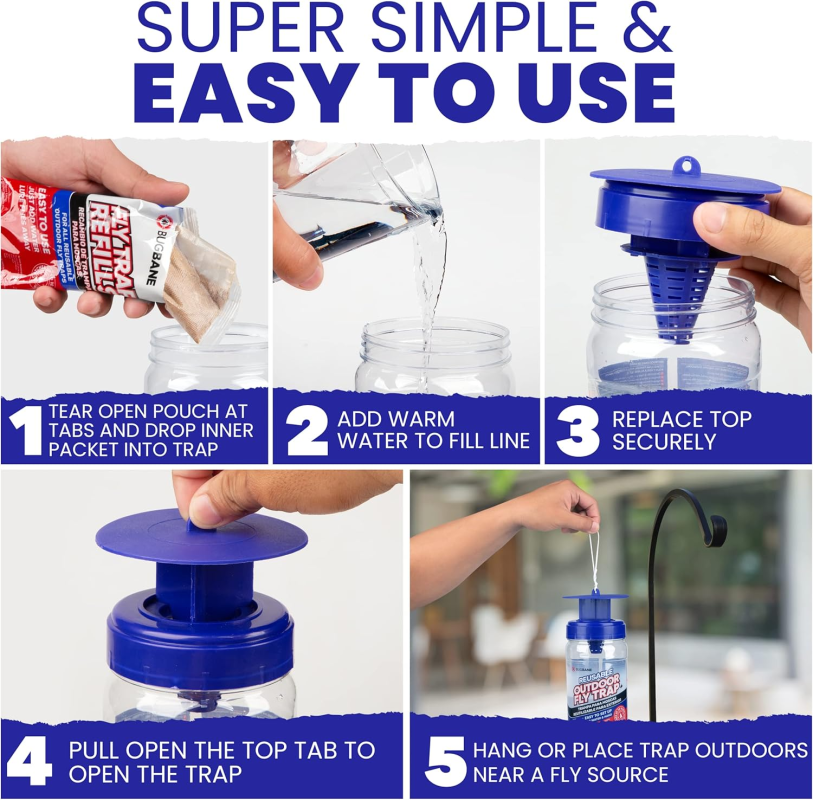
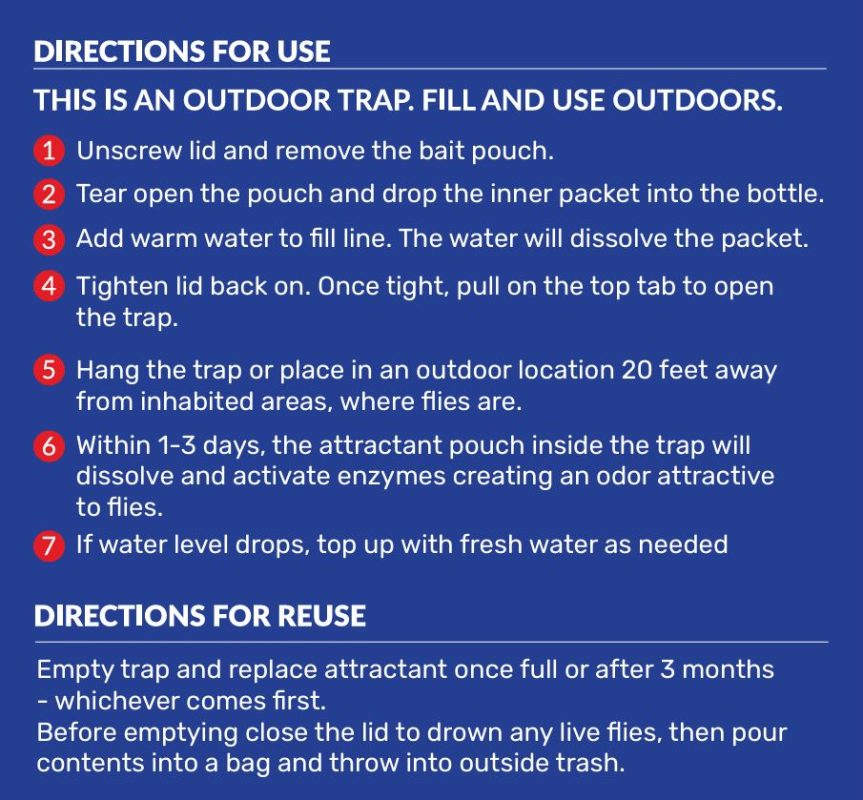
  1. Open: Unscrew the lid and take out the bait pouch.
  2. Add Bait: Tear the pouch open and drop the internal packet directly into the bottle.
  3. Add Water: Fill the bottle with warm water up to the fill line. This dissolves the packet.
  4. Activate: Screw the lid on tight, then pull up the top tab to open the trap’s entry point.
  5. Placement: Hang or place the trap at least 20 feet away from areas where people gather.
Operation & Maintenance
  • Activation Time: It takes 1-3 days for the bait to fully dissolve and begin emitting an odor that attracts flies.
  • Refilling: If the water level goes down, top it up with fresh water.
Disposal and Reuse
You should empty and refresh the trap either when it is full of flies or after 3 months, whichever happens first.
  • To Empty Safely:
    • Close the lid first to drown any remaining live flies.
    • Pour the contents into a bag and dispose of it in an outside trash can.
    • Replace the attractant to start the process over.


To transform your yard from a fly-zone to a “no-fly zone,” it’s all about strategy. Anyone can hang a trap, but these professional-level tips will ensure you get maximum catch rates and minimum annoyance.

The “Sun & Shade” Balance

The bait in BUGBANE traps is biologically activated, meaning it needs heat to ferment. In Spring or Fall, place the trap in direct, all-day sunlight to keep the fermentation bubbling. In the peak of Summer (90°F+), move the trap to a semi-shaded area. Extreme heat can actually kill the “good” bacteria in the bait or cause the water to evaporate in a single afternoon, rendered the trap useless.

Prime the Pump (Pre-Activation)

If you have a big outdoor event (like a BBQ) on Saturday, don’t set the trap on Saturday morning. Set the trap Tuesday or Wednesday. It takes roughly 48 hours for the scent plume to reach full strength. Setting it early ensures the flies are already distracted by the trap before your food hits the grill.

Use “Lure Placement” Logic

Think of the trap as a “decoy.” You want to draw flies away from your house. Hang traps along the perimeter fence or near fly breeding grounds (trash cans, dog runs, or compost piles). If you put the trap on your patio table, you are essentially inviting every fly in the neighborhood to your dinner party.

The “Sweet & Stinky” Boost

If your fly problem is particularly aggressive, or if the bait is taking too long to activate in cooler weather. Add a teaspoon of apple cider vinegar or a small piece of overripe fruit (like a bruised strawberry) to the water when you first set it up. This provides an immediate sugary scent while the main protein bait works on fermenting.

Combatting Evaporation

In dry climates, the water level is the “on/off” switch for the trap. Once the water is gone, the scent stops, and the flies stop drowning. Check the water level weekly. If it’s low, don’t dump it out just top it off. Keeping the “stinky” water active is better than starting fresh every time.

Odor-Free Disposal

Let’s be honest: a full trap smells terrible. That’s why it works! When it’s time to empty the trap, do it in the late evening when fly activity is low. Dig a small hole in your garden (away from the house), pour the contents in, and cover it with 4 inches of soil. The flies and bait act as a high-nitrogen fertilizer for your plants, and the soil instantly seals in the odor.

Dealing with “Smart” Flies

If you notice flies hovering around the trap but not going in.Give the canister a gentle swirl. Sometimes the bait settles at the bottom or a “crust” of flies forms at the surface. Stirring it breaks the surface tension and releases a fresh burst of scent to pull those hesitant flies inside.

Frequently Asked Questions

Our traps attract all common flies, including: house flies, blow flies, flesh flies, stable flies, phorid flies, drain flies, face flies, deer flies, cluster flies and tachinid flies.

First, push down the lid and wait for any live flies inside the trap to drown. Then unscrew the lid and pour the contents into a plastic bag, tie it up, place that in another bag, tie that up, then place in the outdoor trash.

Our bait attract flies from over 30 feet away. We advise replacing the bait after 3 month or once the trap becomes full, which ever is sooner. If the water level drops via evaporation, you can top it up with fresh water as many times as needed.

We use all natural ingredients which are not harmful (egg, fish, bran, yeast), so your dog will be fine.

While it looks gross, this will actually make the trap even more attractive to flies as it will smell even stronger. So you can keep using the trap until it is full, even if maggots start to grow inside.

For the best results, hang the trap about 5 feet off the ground and at least 20 feet away from your outdoor living spaces (patios, decks, or play areas). This ensures flies are drawn away from you rather than toward you.


You should clean and refill the trap when it becomes full of flies or after 3 to 4 weeks, whichever comes first. Over time, the bait may lose its potency or the reservoir may become overcrowded.

In very hot or dry climates, check the water level weekly. If the water drops below the fill line, simply add more to keep the bait submerged. The trap must stay hydrated to remain effective.


Since the bait is non-toxic, you can bury the contents in a garden (they make excellent compost) or seal them in a trash bag for disposal. We recommend doing this outdoors, as the used bait has a very strong odor.