How the trap works

BugBane Window Fly Traps are clear, sticky adhesive strips that catch flies and other small flying insects on contact. Each strip is made from transparent PET film coated with a pressure-sensitive adhesive. The strip is mounted on the inside of a window, where light draws flying insects toward the glass. When an insect lands on the adhesive surface it is held in place. The trap captures insects mechanically and contains no insecticide.

What it catches

The adhesive strip is designed to catch small flying insects, including house flies, cluster flies, gnats, fruit flies, and small moths. It is not designed for larger, stronger insects such as horse flies, large wasps, or stink bugs.

Placement on the window

  • Mount the strip on the inside of a window, where flying insects gather as they move toward the light.
  • The lower corners of the windowpane are a good location, as flies often land and rest near the edges and frame.
  • One strip covers approximately one standard window pane (about 10–15 sq. ft. of glass area).
  • The glass must be clean and dry for the adhesive to bond.

What to expect

  • The strip works on contact; there is no bait period to wait through.
  • Capture depends on insect activity near the window and on the strip remaining exposed and tacky.
  • The adhesive remains tacky for up to 3 months per strip once the protective film is removed.

Materials

The strip is made from a clear PET film with a pressure-sensitive adhesive. It is fragrance-free and odorless and contains no insecticide.

Disposal

When the strip is full of insects, remove it from the surface, wrap it in newspaper, and place it in your regular household trash.
General Product Information
  • Brand: BugBane
  • Model Number:
    Winfly50 – Window Fly Traps – 50 Pack
  • Product Type: Adhesive Insect Trap
  • Primary Function: Capture and containment of flying insects via high-tack adhesive.
  • Target Species: Houseflies, Fruit Flies, Gnats, Cluster Flies, and Moths.
  • Type: Pressure-Sensitive Adhesive (PSA).
  • Activation: Dual-stage peel-and-stick (back-side for mounting; front-side for trapping).
  • Adhesive Category: Designed for a high initial grab so insects cannot pull away once contact is made.
  • Heat Resistance: Rated for glass surface temperatures up to 60°C (140°F) without adhesive migration or dripping.
  • Longevity: Remains active and tacky for up to 3 months per strip once the protective film is removed.
  • Pack Count: 50 individual adhesive strips.
  • Storage: Flat-packed in a moisture-sealed box.
  • Shelf Life: 24 months if stored in a cool, dry place away from direct sunlight.
  • Optimal Surfaces: Smooth, non-porous surfaces (glass, finished acrylic, polished metal).
  • Effective Range: One strip per standard window pane (approx. 10–15 sq. ft. of glass area).
  • Target Species: Musca domestica (housefly), Drosophila (fruit fly), Sciaridae (fungus gnat), and various small moths.
  • Active Ingredients: None (mechanical/physical capture only).
  • Scent: Fragrance-free and odorless.
  • Use Areas: Intended for indoor use. Keep out of reach of children and pets.
  • EPA Establishment Number: 93378-CHN-1
  • This product is a pesticide device under FIFRA. As a pesticide device it is required to bear an EPA Establishment Number identifying the facility where it is produced; it is not an EPA-registered pesticide and does not carry an EPA registration number.
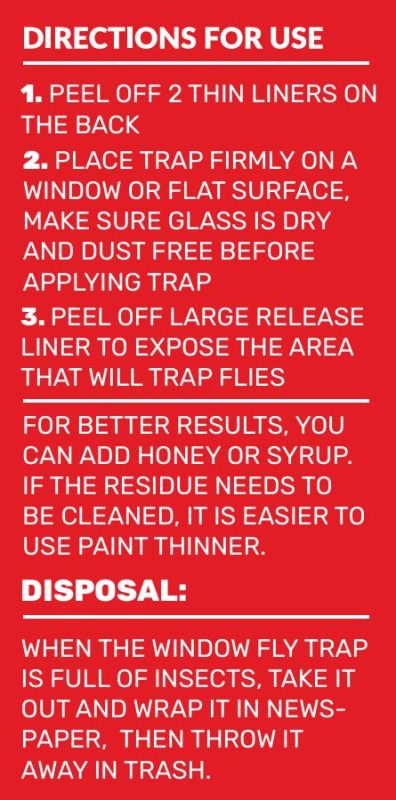
DIRECTIONS FOR USE
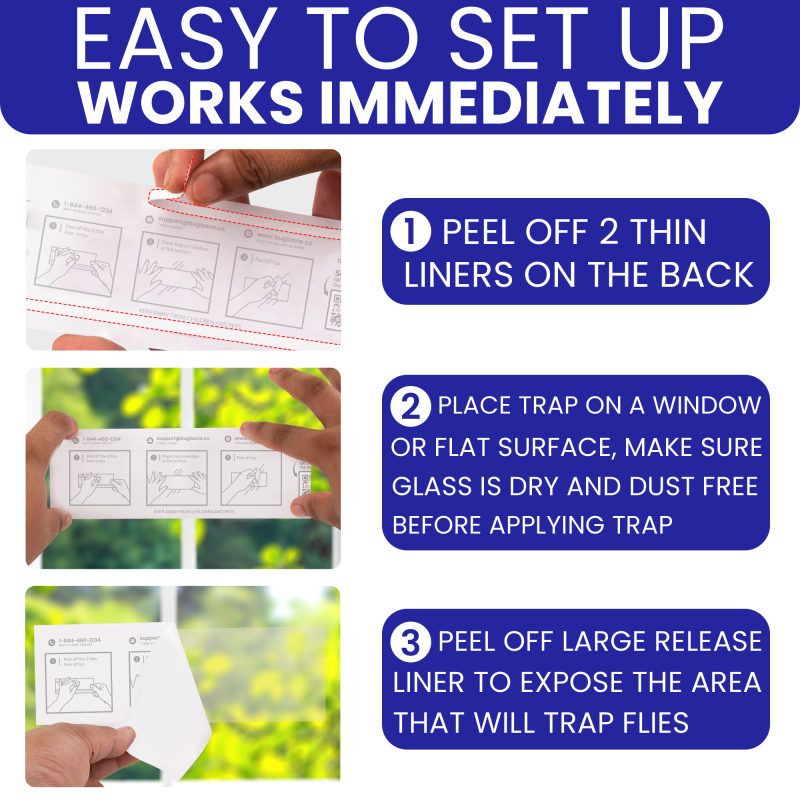
  1. Prep the back: peel off the two thin liners located on the back of the trap.
  2. Mount: firmly press the trap onto a window or any flat surface. Ensure the surface is completely dry and free of dust before you stick it on.
  3. Activate: peel off the large release liner on the front to reveal the sticky surface that catches the flies.

Pro Tips

  • For better results, you can add a small amount of honey or syrup to the trap.
  • If the trap leaves a sticky residue behind, dab with vegetable or mineral oil, then wash with soap and water.

Disposal

When the trap is full of insects, carefully remove it from the surface, wrap it in newspaper, and throw it in your regular trash.

The “Golden Corner” placement

Insects typically fly to the center of a window but eventually crawl toward the edges and corners as they look for an exit.

  • Place your traps in the lower left or right corners of the windowpane. This is where flies most frequently land and rest.
  • If you have double-pane windows, placing the trap near the frame helps catch gnats that tend to hover in the shadows of the window casing.

Preparation is everything

The adhesive is strong, but it won’t stick to dust or grease.

  • Use an alcohol-based glass cleaner or a simple vinegar-water solution to prep the glass. Ensure it is completely dry before applying the strip.
  • If you are applying these during a very cold morning, the adhesive may be less pliable. Warm the glass slightly with a hairdryer or wait until the sun hits the window for a more secure bond.

Leverage light competition

Flies are attracted to the brightest light source.

  • In a room with multiple windows, place traps on the one that gets the most direct sunlight.
  • If you have a fly in the house at night, turn off all the lights except for a small lamp near a window with a trap. The fly will migrate toward that light and likely land on the nearby strip.

Handling and application

  • When peeling off the large protective front film, leave a tiny 2mm sliver of the film on one corner. This gives you a clean spot to grab when it is time to remove the trap later so you do not have to touch the insects or the glue.
  • When applying the narrow mounting strip to the glass, use the edge of a credit card to squeegee out any air bubbles. This keeps the trap flat so it does not interfere with window screens or blinds.

Frequently Asked Questions

The trap will catch small flying insects, including house flies, cluster flies, gnats, fruit flies, small wasps, and moths. It will not work well for larger, stronger insects like horse flies, large wasps, or stink bugs.

It works best on the inside of windows, because most flies are attracted to light and fly into the window where they hit the trap. You can stick it to other surfaces such as metal or tile, as long as they are flat and clean. If the surface is not flat and clean, the trap will not stick properly.

The trap is bait-free and odorless. When used on a window, sunlight is the attractant. If you want to trap fruit flies, you can stick the trap above a cup of vinegar with a little dish soap in it. For drain flies, stick the trap above the problem drain.

The top and bottom edges of the trap are glue-free, so you can hold either edge when removing the trap. The adhesive remains tacky for up to 3 months per strip; replace the strip when it is full or once the adhesive is no longer tacky. In very dusty environments the trap may need replacing sooner.

Under normal conditions it should not, but if the glass gets very hot it might release some residue. If this happens, you can scrape it off with a razor, or use vegetable or mineral oil or 70%+ rubbing alcohol.

Yes, provided there is enough clearance. Because the strips are ultra-thin (approx. 1mm), they usually do not interfere with the sliding mechanism of doors or window screens.