How the trap works

Reusable Outdoor Fly Traps use a water-activated bait to attract and capture filth flies. The bait is supplied as a dissolvable refill packet. You drop a packet into the reusable bottle and add warm water, which dissolves the packet and begins a natural fermentation process. Over the next 1 to 3 days the bait releases a scent that draws flies into the trap through a one-way entry cone, where they are caught and cannot escape. The trap works by scent-based attraction and contains no insecticides.

What it catches

The bait is formulated to attract filth flies, including house flies, blow flies, bottle flies, and flesh flies. It is not designed to attract pollinators such as bees and butterflies.

What to expect

  • Allow 1 to 3 days to activate. It is normal to see few or no flies during this fermentation period, and effectiveness increases as the temperature rises.
  • More fly activity near the trap at first is normal. The trap draws flies from the surrounding area as it pulls them away from your living space. Hang it at least 20 feet from patios, doors, and windows.
  • Warmth and sunlight speed up activation. The bait requires ambient temperatures above 65 degrees F (18 degrees C) for fermentation, so place the trap in a sunny spot for the best results.
  • A strong odor is normal and is what attracts the flies.

Reusable construction

The trap is a rigid, semi-transparent bottle with a one-way entry cone and a top cap that helps keep rainwater out while directing the scent outward. The semi-transparent housing lets you monitor the fill level without opening the unit. The trap is reusable across the season; only the bait packet is replaced each cycle.

Bait composition

The bait is a granular, water-soluble, protein-based attractant made from food-grade ingredients (dried whole egg solids, sucrose, yeast, and fermented fish meal) and contains no insecticides. It is biodegradable.

Bait cycle and disposal

Replace the bait packet about every 3 to 4 weeks (21 to 30 days), or sooner if the trap fills with flies. Empty and clean the trap when it is full or at the end of the season. To empty, close the lid to drown any remaining live flies, then pour the contents into a bag and dispose of it in an outdoor trash can. Because the bait is food-grade, the contents may also be buried in a garden as a high-nitrogen soil amendment.
General Product Information
  • Brand: BugBane
  • Model Number:

FlyTraR1-V2 – Reusable Outdoor Fly Traps – 1 Pack

FlyTraR2 – Reusable Outdoor Fly Traps – 2 Pack

FlyTraR3 – Reusable Outdoor Fly Traps – 3 Pack

  • Product Type: Outdoor Fly Control
  • Target Species: House flies, Blow flies, Bottle flies, and Flesh flies.
  • Main Reservoir: Impact-resistant; semi-transparent for level monitoring.
  • Entry Cone: Smooth-walled interior to prevent fly traction/escape.
  • Top Cap: Prevents dilution from rain; contains odor plume.
  • Suspension System: Rust-proof; includes “S” hooks for various mounting diameters.
  • Dimensions: 22.8 cm (H) x 7.6 cm (D)
  • Volume Capacity: 750 ml per unit. Capable of holding approx. 20,000 flies per cycle.
  • Formulation: Granular, water-soluble protein-based attractant.
  • Ingredients: Dried whole egg solids, sucrose, yeast, and fermented fish meal.
  • Environmental Impact: Biodegradable; suitable for disposal in soil or municipal waste systems.
  • Refill Specs: 20 g dissolvable packets; vacuum-sealed for shelf-life stability (up to 2 years stored in a cool, dry place).
  • Activation Threshold: Requires ambient temperatures above 65 degrees F (18 degrees C) for microbial fermentation.
  • Attraction Radius: Effective up to 35 feet (10.6 meters) per trap under moderate wind conditions.
  • Targeted Species: Musca domestica (Common House Fly), Calliphoridae (Blow/Bottle Flies), Sarcophagidae (Flesh Flies).
  • Cycle Duration: 21 to 30 days (dependent on fly density and evaporation rates).
  • Placement Height: 1.2 m to 1.8 m (4 to 6 feet) above ground level.
  • Strategic Positioning: Perimeter placement; minimum 6 meters from human activity.
  • Water Requirements: Requires potable or non-chlorinated water for initial activation (fill to indicated line).
  • Maintenance: Rinse with warm water between bait cycles; no harsh detergents required.
  • Disposal: Contents may be used as an organic fertilizer (burying recommended due to odor).
  • Storage: Keep refills away from moisture and direct sunlight until ready for use.
  • Precautions: Keep out of reach of children and pets.
  • Pesticide Status: This product has not been registered by the United States Environmental Protection Agency. BugBane represents that this product qualifies for exemption from registration under FIFRA.
DIRECTIONS FOR USE
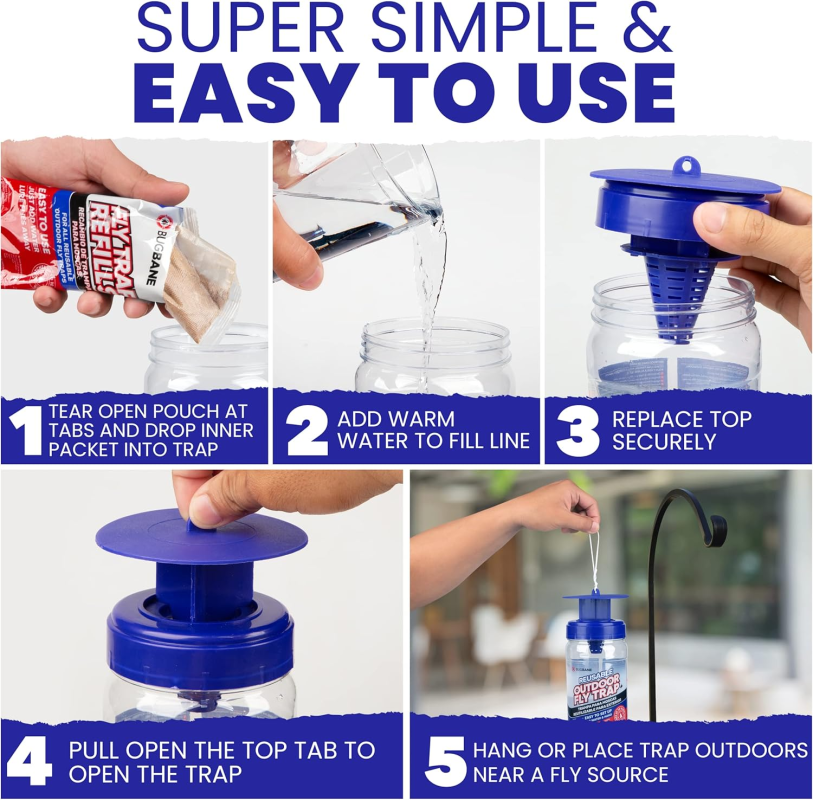
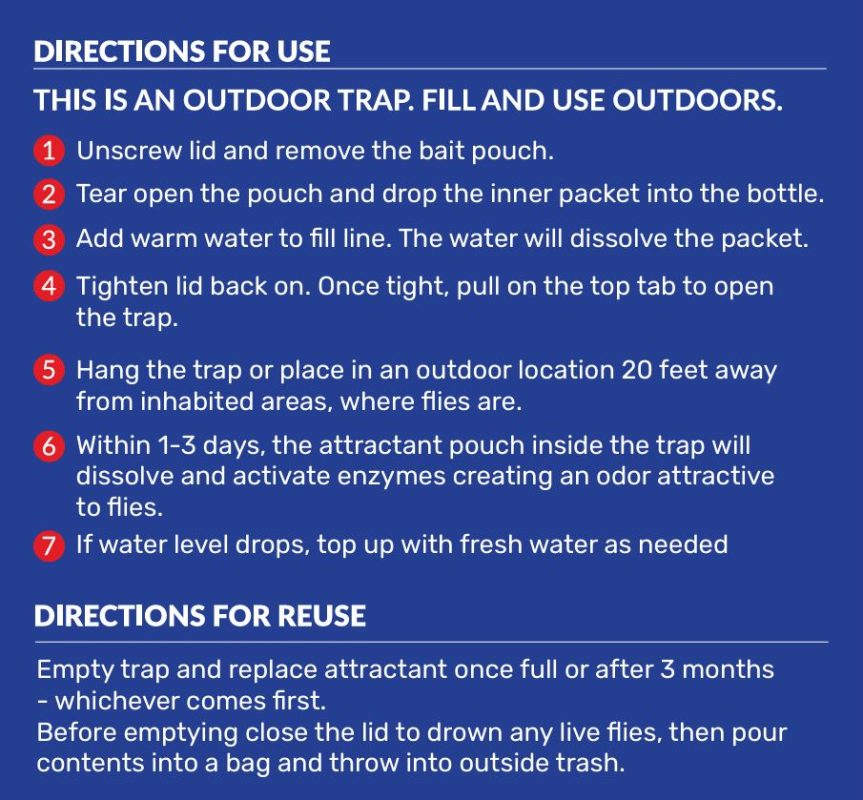
  1. Open: Unscrew the lid and take out the bait pouch.
  2. Add Bait: Tear the pouch open and drop the internal packet directly into the bottle.
  3. Add Water: Fill the bottle with warm water up to the fill line. This dissolves the packet.
  4. Activate: Screw the lid on tight, then pull up the top tab to open the trap’s entry point.
  5. Placement: Hang or place the trap at least 20 feet away from areas where people gather.

Operation & Maintenance

  • Activation Time: It takes 1 to 3 days for the bait to fully dissolve and begin emitting an odor that attracts flies.
  • Refilling: If the water level goes down, top it up with fresh water.

Disposal and Reuse

Replace the bait about every 3 to 4 weeks (21 to 30 days), or sooner if the trap fills with flies. Empty and clean the trap when it is full or at the end of the season.

  • To Empty Safely:
    • Close the lid first to drown any remaining live flies.
    • Pour the contents into a bag and dispose of it in an outside trash can.
    • Replace the attractant to start the process over.

To get the most out of your BugBane Fly Traps, follow these placement and maintenance strategies.

The “Sun & Shade” Balance

The bait in BugBane traps is biologically activated, meaning it needs heat to ferment. In Spring or Fall, place the trap in direct, all-day sunlight to keep the fermentation going. In the peak of Summer (90 degrees F and above), move the trap to a semi-shaded area. Extreme heat can kill the beneficial bacteria in the bait or cause the water to evaporate quickly, reducing effectiveness.

Prime the Pump (Pre-Activation)

If you have a big outdoor event (like a barbecue) coming up, set the trap a few days early. It takes roughly 48 hours for the scent plume to reach full strength. Setting it early ensures the flies are already drawn to the trap before your food is out.

Use Lure-Placement Logic

Think of the trap as a decoy. You want to draw flies away from your house. Hang traps along the perimeter fence or near fly breeding grounds (trash cans, dog runs, or compost piles). Placing the trap on your patio table can draw more flies toward your living space.

The “Sweet & Stinky” Boost

If your fly problem is particularly heavy, or if the bait is taking too long to activate in cooler weather, add a teaspoon of apple cider vinegar or a small piece of overripe fruit (such as a bruised strawberry) to the water when you first set it up. This provides an immediate sugary scent while the main protein bait works on fermenting.

Combatting Evaporation

In dry climates, the water level controls whether the trap is active. Once the water is gone, the scent stops. Check the water level weekly. If it is low, top it off rather than dumping it out. Keeping the active water in place works better than starting fresh each time.

Odor-Free Disposal

A full trap has a strong odor. When it is time to empty the trap, do it in the late evening when fly activity is low. Dig a small hole in your garden (away from the house), pour the contents in, and cover it with about 4 inches of soil. The flies and bait act as a high-nitrogen fertilizer for plants, and the soil seals in the odor.

Dealing with Hesitant Flies

If you notice flies hovering around the trap but not going in, give the canister a gentle swirl. Sometimes the bait settles at the bottom or a crust forms at the surface. Stirring it releases a fresh burst of scent to draw those hesitant flies inside.

Frequently Asked Questions

Our traps attract common filth flies, including house flies, blow flies, flesh flies, stable flies, phorid flies, drain flies, face flies, deer flies, cluster flies, and tachinid flies.

First, push down the lid and wait for any live flies inside the trap to drown. Then unscrew the lid and pour the contents into a plastic bag, tie it up, place that in another bag, tie that up, then place it in the outdoor trash. Replace the bait packet to start a new cycle.

The bait attracts flies from up to 35 feet away. Replace the bait about every 3 to 4 weeks (21 to 30 days), or sooner once the trap becomes full. If the water level drops through evaporation, you can top it up with fresh water as many times as needed.

The bait contains no insecticides, only food-grade ingredients (egg, fish meal, bran, and yeast). Keep traps out of reach of pets and children, because the contents are unsanitary once flies are caught. If your pet ingests the bait or you have any concerns, contact your veterinarian.

While it looks unpleasant, maggots make the trap even more attractive to flies because the scent grows stronger. You can keep using the trap until it is full, even if maggots begin to grow inside.

For the best results, hang the trap about 5 feet off the ground and at least 20 feet away from your outdoor living spaces (patios, decks, or play areas). This draws flies away from you rather than toward you.

Clean and refill the trap when it becomes full of flies or after 3 to 4 weeks (21 to 30 days), whichever comes first. Over time, the bait may lose its potency or the reservoir may become overcrowded.

In very hot or dry climates, check the water level weekly. If the water drops below the fill line, add more to keep the bait submerged. The trap must stay hydrated to remain effective.

Because the bait is made from food-grade ingredients, you can bury the contents in a garden (they make good compost) or seal them in a trash bag for disposal. We recommend doing this outdoors, as the used bait has a very strong odor.