
Flies don’t follow a fixed calendar date — fly season follows the weather. Across most of the United States, fly activity ramps up in mid-to-late spring, peaks in the hot, humid stretch of summer, and fades as fall sets in. But the exact timing shifts by region: a household in the Southeast deals with flies earlier — and longer — than one in the Upper Midwest. The map below shows when fly pressure peaks where you live.
Fly season by region (U.S. heat map)
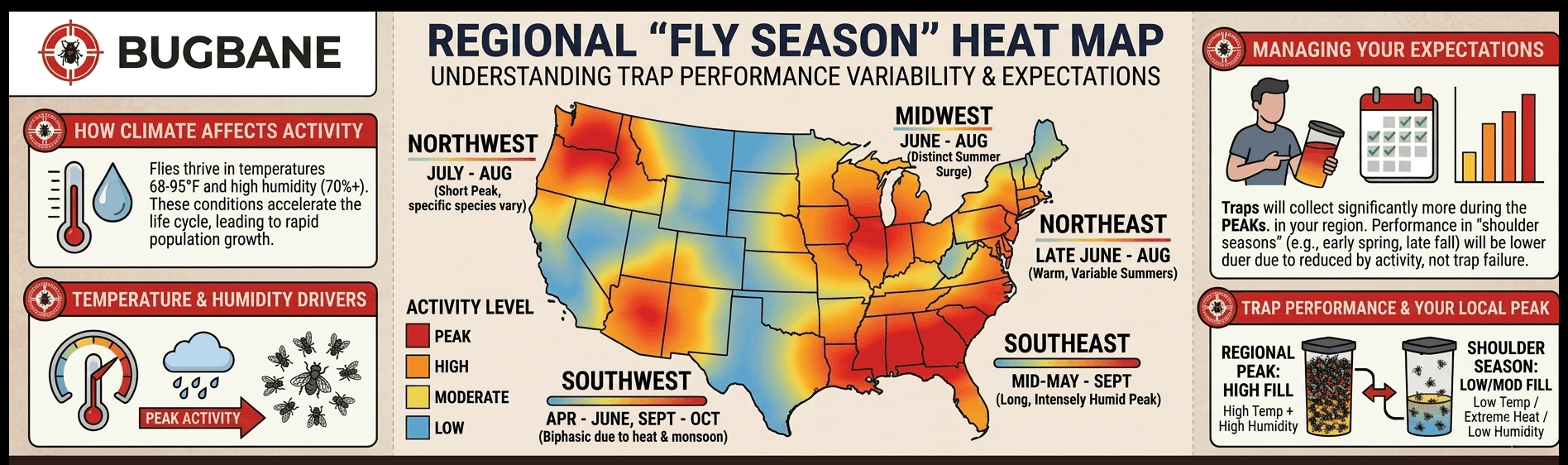
Find your region on the map to see its peak-activity window and how intense that peak typically gets. One pattern holds everywhere: the warmer and more humid your climate, the earlier fly season starts and the longer it runs. Southern and coastal regions see long seasons with high peaks; northern and higher-elevation areas get a shorter, sharper burst in midsummer.
What drives fly activity: temperature and humidity
Two things set the pace of a fly season: heat and moisture. Warmth speeds up the fly life cycle — eggs hatch and new flies mature faster as temperatures climb — so a hot spell can turn a minor nuisance into a swarm in a couple of weeks. Humidity matters because flies need moisture to breed, and the damp organic matter they lay eggs in stays viable longer in humid air. When both line up — hot and humid — you’re in peak season.
When does fly season start and end?
As a rule of thumb, flies become noticeable once daytime temperatures hold above roughly 60°F and accelerate past 70°F. Activity winds down as nights cool in fall; once temperatures stay below about 50°F, most flies go dormant or die off and the survivors overwinter. In the warmest southern regions flies never fully disappear — they just drop to a low simmer in the cooler months. Your region’s start and end points are on the map above.
Why some years — and some weeks — are worse
No two fly seasons are identical, even in the same town. A mild winter lets more flies survive into spring; a warm, wet spring gives them an early head start; and a midsummer heat wave can trigger a spike in days. That’s why flies can seem to appear “everywhere” for a week or two — local weather, not anything you did, is usually the cause.
What to expect from a fly trap through the season
Because fly numbers swing so much, your trap’s catch swings with them — and that’s normal. During your regional peak a trap can fill fast; in the off-season the same trap may catch very little, simply because there are far fewer flies around. A near-empty trap in October isn’t a broken trap — it’s a sign the season is ending. Sizing your expectations to your local peak is the key to getting the most from any trap.
- Reusable Outdoor Fly Trap — for season-long coverage
- Disposable Outdoor Fly Traps — grab-and-go through the peak
- Window Fly Traps — for the ones that get indoors
- Fly Sticks — cheap, targeted sticky coverage
- Fly Ribbons — hang-up coverage for porches and barns
How to stay ahead of fly season
- Start early. Get traps out before your regional peak — knocking down the first generation keeps later ones smaller.
- Place outdoor traps away from where you gather. Traps lure flies, so set them toward the edge of the yard or patio, not next to the table.
- Cut off breeding sites. Empty trash, clean up pet waste, and remove standing water and rotting organic matter — fewer breeding spots, fewer flies.
- Layer indoor and outdoor. Pair an outdoor trap with window traps or ribbons.
See our full Fly Control guide for product-by-product help.
Fly season FAQ
When does fly season start?
In most of the U.S., fly activity picks up in mid-to-late spring as temperatures pass ~60°F, then accelerates into summer. Check the heat map for your region’s start window.
When does fly season end?
Populations taper as nights cool in fall and largely go dormant once temperatures stay below ~50°F. In warm southern regions, low-level activity can persist most of the year.
What month are flies worst?
For most regions, flies peak in the hottest, most humid stretch — typically June through August. Your local peak is on the map.
Why are there so many flies this year?
Warm, wet springs and early heat waves let flies complete more breeding cycles, so a mild winter or humid spring often means a heavier season.
Do fly traps catch more at certain times?
Yes — traps collect far more during your regional peak and less in the off-season. That’s expected, not a sign the trap isn’t working.
What temperature is too cold for flies?
House flies turn sluggish below ~50°F and are mostly inactive near freezing; they’re most active in warm, humid conditions.
Ready for the season? Shop BugBane’s fly traps on Amazon.